Sunday, 28 November 2010
'An insult to the people of Hackney' or an injury?
Sunday, 21 November 2010
Hackney Gazette and ELA leave East End (after 144 years)
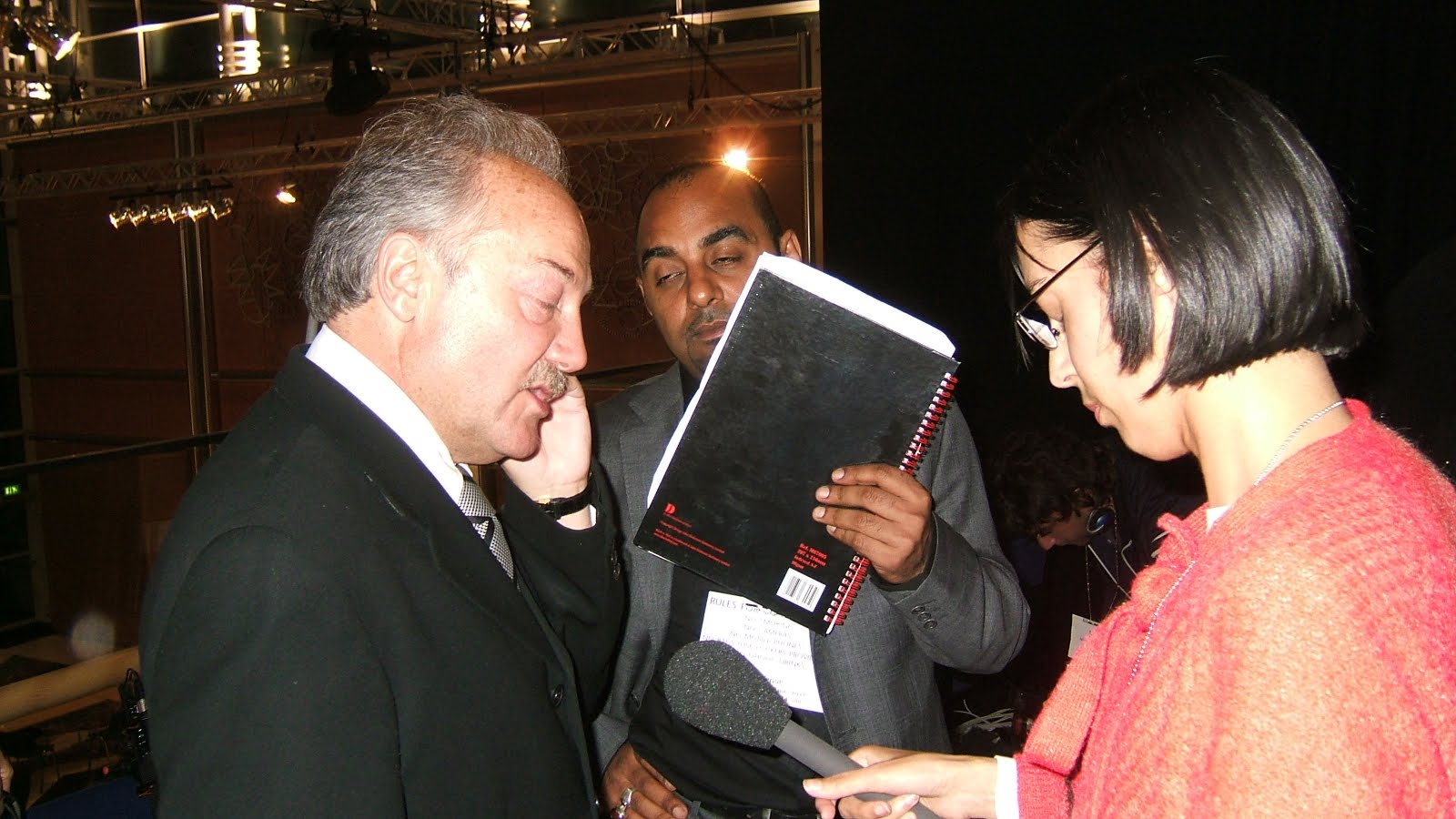
The picture was taken in June 2005 (The date can be seen above Ricin 'Terrer') when East London was buzzing with terror threats.
Another comment came from 'Localreporter': I work on one of the above papers, about to be moved to Ilford - miles off patch.Since the centralised CMS system was introduced not long ago, which is obviously enabling this move, it has been evident that quality has declined. We are often being told to "write to fit" the space provided, so stories with worth are being squeezed into nib size, and rubbish that would normally be used as space fillers is being given more room than it deserves. All so that pages can be "sent off" to production, and all part and parcel of this centralised subbing system. Working in Ilford, several miles and over an hour's journey off patch, is going to be yet another recipe for disaster. All very demoralising..."
Saturday, 20 November 2010
Hackney public sector employees: 16,000 or 60,000 or 130,000?
September: 9,927 (6.6%) - (9,927/0.066=150,409) (+136)
July: 9,466 (6.3%) - (9466/0.063= 150,253) (+60)
June : 9,406 (6.5%) (9,406/ 0.065 = 144,707)
May: 9,616 (6.7%) (9,616/.067=143,522)
April: 9,663 (6.7%) (9,663/.067=144,223)
March: 9,846 (6.8%) (9,846/0.68=144,794)
February: 10,044 (7%)
January: 9,905 (6.9%)
December: 9743 (6.7%)
November: 9,795 (6.8%)
October: 9,827 (6.8%)
September: 9,884 (7%)
August 9,826 (6.9%) (+276)
July: 9550 (6.7%) (+242)
May: 9,377 (6.6%) (+379)
November - 7,013 (4.9%)
Sept - 4,772 (6.2%) - (4,709/0.062=76,967)
January - 4,402 (6.3%) - (4,402/0.063=69,873)
2009
Hackney South
Sept - 5,140 (7.3%) - (5,140/0.073=70,410)
June - 4,851 (7.0%) - (4,851/0.07= 69,300)
Sunday, 14 November 2010
Pipe Vs Pickles: but will Ken be more dangerous?

“I need no lectures from you on efficiency,” Jules Pipe told Eric Pickles, minister in charge of imposing cuts on councils like Hackney. The report came via the Local Government Chronicle chief reporter's blog - about the London Councils summit (pics) on November 6.
Diane Abbott: never get involved in politics of racial division
Diane Abbott: "The Labour Party should never get involved in the politics of racial division."
Zebras Vs Pelicans: Beechholme and Environs...
A bit of gossipy stuff -Seen first in Hackney Hive but it's in this 'Duchess of 'ackney' blog.
All stemming from this in the Hackney Gazette which then supported Cllr Louisa Thomson here
Sunday, 7 November 2010
Chatsworth Road Market pics
A busy day on Chatsworth Road. Congratulations to any one involved.
I bought a pie and some jam. There were lots of people hopefully buying more than just pie and jam. Here's a review from another blogger at Clapton Is Good: http://claptonisgood.tumblr.com/post/1509562096/chatsworth-rd-market
Good luck with the next one.
Democracy problem in Stamford Hill on the mend?
How, we all ask, has it come to this? Where have we gone wrong? Is this the result of a (non-existent) fair admissions policy? Is it the influence of having, G-d forbid, parents with tops which indicate a shape beneath and skirts which hint at legs ambulating within?
Sunday, 31 October 2010
Did gangs close Hackney youth centre?
Blue Hut - Peer Support Programme
The Peer Support Programme is a pilot project currently being run by SkyWay organisation at the Blue Hut and there has been huge interest from young people wanting to be involved in it. It is teaching the young people involved that they can give something back to their community and become positive role models for their peers. Through the programme, they can show there is an alternative to the gangs many young people will see on a daily basis and provide positive role models to the youngsters in their areas.
The programme has been running since October 2009 in its current form although a pilot project on a much smaller scale was run from March 2009 with 3 peer coaches.
In total there have been fifteen young people involved in the programme so far and their ages range from fifteen to twenty four
Page 184years, although most of the young people involved have been between seventeen and twenty one years.
The young people receive support through the development of an individual learning plan, and as part of this they received an in-depth initial meeting and then monthly one to ones which focus on their progress and development in relation to their individual learning plan. The peers specialise in one area, such as drama or sport, and they report to a specific member of staff who is trained in their area of interest and who can offer them continued support and advice. The peers also complete training which is both accredited and non- accredited.
The peers all complete a ‘train the trainer’ course, and this included units on safeguarding, working with young people, running activity sessions, equality and diversity, and confidentiality and data protection. They also completed an enterprise training programme over 4 days. The peers also complete training on working with young people in relation to drugs and alcohol.
Peers are recruited to support activities across all aspects of SkyWay’s programmes and therefore they have sports peers, media peers (music and film), youth work peers and bike maintenance peers. All of the young people involved receive training and paid work experience in the area they are interested, for example sports coaching, media sessions or youth work. The work that they do is constantly monitored and only once the workers are confident in the young people’s abilities and skills and they have completed the relevant training and have had an enhanced CRB check will they be allowed to lead sessions with other young people.
In addition to this, each peer will complete qualifications that are relevant to their interests and will be identified through their individual learning plan; this could include for example Level 1 or 2 in FA football coaching or Level 2 in Youth Work.
The Peer Support Programme has been increasingly popular with young people and it is currently oversubscribed. Staff at the Blue Hut said that the results so far have been very positive and they have seen a number of the peers grow in maturity & confidence, and the young people involved have developed communication, self reliance, team working and leadership skills.
The Commission members talked to one of the young people involved in the Peer Support Programme who told them he felt it was important to develop young people through the programme as it helps to bridge the gap between the young people and youth workers.
Page 185
Recommendation Three
The Commission was impressed during the site visits and through talking to young people by the range of training and qualifications young people are able to gain through youth centres and activities and strongly support and encourage these opportunities.
The Commission was particularly interested in the Peer Support Programme run by SkyWay organisation at the Blue Hut and its aim to develop young people to lead activity sessions with their peers and younger age groups.
The Commission recommends the Youth Service look at the Peer Support Programme currently being run by SkyWay organisation at the Blue Hut and consider adopting a similar model in council maintained youth centres in Hackney.
Saturday, 30 October 2010
Fighting evil powers at work in Hackney

Apart from Glamorous Gardener's terrifying cake party there wasn't much Halloween stuff going on in Hackney blogs.
Sunday, 24 October 2010
Hackney Gazette has new website that allows comments
Turkish crime - Turkish politics
This month a team of Hackney police officers returned home from a trip to Turkey. The trip was to "learn more about the culture, to strengthen existing relationships with Hackney's Turkish and Kurdish communities."
Last week the BBC published this story: "Could Turkish and Kurdish gangs become the new 'mafia'?"
The BBC investigation mentions another character, Nurretin Guven. He, and another convicted drug dealer, Hamit Gokenc, were both allegedly linked to a right-wing nationalist group and to attempts to capture or assassinate PKK and MLPK leaders. (Most of these links were taken from this article: Turkish Conflicts: PKK, Grey Wolves. I don't know if the claims made in it are correct.)
The BBC's 2006 story about a clampdown on the notorious Bombacilar said: "Matters came to a head on 9 November 2002 when the Bombacilar clashed with their PKK/Kadek rivals" which led to a street battle along Green Lanes and the death of one man. The PKK being the far-left Kurdish nationalist party and listed as terrorist organisation in the USA and Europe.
The violence errupted again in 2009 with several tit-for-tat shootings but this time the Bombacillar were believed to be in conflict with the Tottenham Boys. According to the Evening Standard both gangs are Turkish Kurds.
Blood and Property spoke to a Turkey expert from a well-known London-based institution who did not want to be named. He said that Turkish communities, like those in Hackney and Haringey, were more polarised than Turkish/Kurdish communities in Turkey itself. He also said that events, like a recent PKK terrorist attack in Istanbul, could result in increased tensions in communities like those in North London.
A piece of research done in 2008 by academics at Sussex University:
"Since the enactment of the 2001 Terrorism Act in the UK, the PKK has been listed as a terrorist organisation by the UK government. Kurds from Turkey who claim asylum in the UK stating persecution due to membership of, or association with, the PKK could risk imprisonment under the Terrorism Act. At the same time (2000) the Kurdish television station MED-TV, which was broadcast from the UK, was closed down by the British government due to breaches of impartiality and claims that it incited people to commit criminal acts. These events highlight how diaspora politics and the struggle for Kurdish national recognition have the potential to escalate into a sensitive political issue between the UK and Turkey."
But then the same research suggests it's more to do with integrating into life in a Western city:
According to academic research:
In policy terms, the absence of youth centres, and hence of activities for young immigrant
origin people to engage in, is seen as one reason behind the growth of Turkish and Kurdish gangs. These gangs are usually ethnically differentiated, although some mixing occurs too, according to our key informants. Identity is seen as a central issue:
If they don’t belong to an identity, they tend to do a lot of criminal, anti-social behaviour. They form mafia street-gangs. Fighting and anti-social behaviour is becoming a problem (community centre representative). Whether the problem of youth crime lies in issues of identity, or lack thereof, is a moot point. What is less contentious is the strong correlation between poverty and alienation."
A quote from the "'Turks' in London: Shades of Invisibility and the Shifting"
This is why their community organisations insist that using the term ‘Turkish-speaking community’ is not neutral: it implies that ‘Turkish Kurds’ somehow ‘belong’ to Turkey, and that their separate Kurdish identity does not merit recognition. Their claims as a people and nation are at times found to be at odds with anti-terrorist legislation in the UK and with the UK’s position in favour of Turkey joining the EU.10
9 In practice, the centres which call themselves ‘Turkish and Kurdish community centres’ are either Turkish- or Kurdish-dominated, with a very small minority of Turkish Cypriots involved.
10 Since the enactment of the 2001 Terrorism Act in the UK, the PKK has been listed as a terrorist organisation by the UK government. Kurds from Turkey who claim asylum in the UK stating persecution due to membership of, or association with, the PKK could risk imprisonment under the Terrorism Act. At the same time (2000) the Kurdish television station MED-TV, which was broadcast from the UK, was closed down by the British government due to breaches of impartiality and claims that it incited people to commit criminal acts. These events highlight how diaspora politics and the struggle for Kurdish national recognition have the potential to escalate into a sensitive political issue between the UK and Turkey.
In policy terms, the absence of youth centres, and hence of activities for young immigrant origin people to engage in, is seen as one reason behind the growth of Turkish and Kurdish gangs. These gangs are usually ethnically differentiated, although some mixing occurs too, according to our key informants. Identity is seen as a central issue:
If they don’t belong to an identity, they tend to do a lot of criminal, anti-social behaviour. They form mafia street-gangs. Fighting and anti-social behaviour is becoming a problem (community centre representative). Whether the problem of youth crime lies in issues of identity, or lack thereof, is a moot point. What is less contentious is the strong correlation between poverty and alienation.
Joseph Rowntree Foundation, 2005: Young Turks and Kurds: a set of invisible disadvantaged groups.
"There is clearly an ethnic enclave present, consisting not just of sandwich and kebab shops but many other family businesses that provide extensive services and, in many ways, a parallel micro-economy. This is clearly a resource not often available to all disadvantaged groups, for example to indigenous white working-class neighbourhoods. But it has to be stressed that this resource comes at a price. Its presence may be a contributing factor in the young people's relative disengagement with the broader structure of labour market opportunities and can lead to them being trapped in the ethnic enclave.
"The young people are ambivalent about what it means to be British and reluctant to adopt that identity. Yet at the same time, most do not simply use a Turkish identity either. They usually choose multiple ethnic identities, but in the majority of cases, the term 'British' is not (yet) part of that plurality. This is complicated by the fact that the majority of Kurds refused to self-identify as Turks."
Boris follows Jude to Petchey Academy
Sunday, 17 October 2010
Pipe sets spin to positive for cuts
Meg Hillier: fears for her seat
Diane on black pupils and concentration
Saturday, 16 October 2010
What do Operation Trident cuts mean for Hackney?
According to data provided to Blood and Property by Operation Trident under a Freedom of Information Act request, Hackney is its second biggest customer. In 2008-9 Trident had a £28m budget and employed 359 police officers. Over the last four years Hackney has seen 110 cases, 10% of Trident's case load, being investigated.
This debate on youth crime took place in Parliament in September 2010. No Hackney MPs were there (both probably busy with the Labour leadership)
But David Lammy (Tottenham) (Lab) asked: "Can the hon. Gentleman confirm whether a decision has been made by Boris—the Mayor of London—to cut the marketing budget of Operation Trident? It is important that we should be able to communicate with the young people of London in order to deflect them from crime, so can the Minister comment on whether that is, in fact, true?"
James Brokenshire: "I am afraid that I cannot give him a direct answer to the specific point that he raises about any decision that the Mayor may or may not have made on Operation Trident. However, I should be happy to make inquiries and, as required, write to him if that would be of assistance to him."
It looks like similar cuts to Operation Trident's PR machine were done before, in 2008: "The cuts in adspend will mean less high profile campaigns such as the Metropolitan Police's Operation Trident campaign, created by Miles Calcraft Briginshaw Duffy, to fight gun crime."
The issue of advertising and challenging the perceptions of the black community and the police were addressed by the Met's armed police CO19 back in May 2010 (on the day of the London Fields Shooting). This highlighted a number of persistent beliefs within the black community about subjects like police corruption.
Friday, 15 October 2010
Unemployment rises by 136 claimants ahead of cuts
September: 9,927 (6.6%) - (9,927/0.065=150,409) (+136)
July: 9,466 (6.3%) - (9466/0.063= 150,253) (+60)
June : 9,406 (6.5%) (9,406/ 0.065 = 144,707)
May: 9,616 (6.7%) (9,616/.067=143,522)
April: 9,663 (6.7%) (9,663/.067=144,223)
March: 9,846 (6.8%) (9,846/0.68=144,794)
February: 10,044 (7%)
January: 9,905 (6.9%)
December: 9743 (6.7%)
November: 9,795 (6.8%)
October: 9,827 (6.8%)
September: 9,884 (7%)
August 9,826 (6.9%) (+276)
July: 9550 (6.7%) (+242)
May: 9,377 (6.6%) (+379)
November - 7,013 (4.9%)
Sept - 4,772 (6.2%) - (4,709/0.062=76,967)
January - 4,402 (6.3%) - (4,402/0.063=69,873)
2009
Hackney South
Sept - 5,140 (7.3%)- (5,140/0.073=70,410)
June - 4,851 (7.0%) - (4,851/0.07= 69,300)
Sunday, 10 October 2010
Cuts could cause Jewish influx into Hackney state schools?
Blood and Property: I've been told that some parents who applied for their daughters to go to the school were originally denied but were then accepted after an appeal process. Were you aware of this?
Learning Trust: All requests for information are directed to the school This reply is unacceptable.
Learning Trust: At the last Ofsted the school was judged outstanding. This has been achieved under the leadership of the head and the Governing body, the hard work of its teaching staff and students as well as the support of parents
Learning Trust: No
Sunday, 3 October 2010
A third of teachers leave Hackney academy, claim
When Blood and Property asked Jules Pipe, elected Mayor of Hackney, if the Freedom of Information Act should apply to academies: (Jules Pipe answers Blood and Property questions) he said: "The Freedom of Information of Act should indeed apply to Academies. They are not currently subject to the FoI Act, however..."
Friday, 1 October 2010
Doubt over Homerton A&E future
This blogger - 20goto10 - left a comment on Blood and Property on Thursday which suggests that Homerton Hospital's accident and emergency department is a likely target for NHS cuts. You can find the original post here which was based on this Hackney Communist site's claim that with: "Cuts of up to 187 million over next three years in Hackney NHS; Homerton Hospital might shut down the Accident and Emergency, Stroke and Maternity Departments, replaced by smaller GP units, polyclinics."
Re: closure of the Homerton Emergency Department - it may be on the horizon in the next 5 years or so. The North-East quadrant of London has lots of Emergency Departments covering it (Newham, Royal London, Whittington and Whipps Cross are all close by just to mention a few).
NHS London is definitely looking to swing the axe, especially given the pressure from the Condems, and also because their plan to close the Whittington collapsed on the altar of an election promise by then-Health Secretary Andy Burnham. For many years now King George's in Ilford has had the sword hanging over it and it looks like it will fall for sure.
However, NHS London are still looking round for another victim. Emergency Departments (EDs, no longer called A&E) are expensive to run because of the staffing levels required and the other (non-Emergency Medicine) specialties who are required on-call in the hospital to see many of the patients. Unfortunately the powers-that-be that run hospitals at 100% bed capacity also think that an ED isn't pulling its weight unless it's bursting at the seams and looks like the Alamo every Friday night. The Homerton ED is not like that, partly because it is a very well-run department with out-of-hours GPs resident and partly because the workload simply isn't as bad as one might expect for Hackney (stabbings and shootings go straight to the Royal London).
This is a good thing for patients as it means doctors can spend a bit more time and thought on them, but shamefully also means that it isn't 'busy enough' to justify its existence. I have spoken to a few people in other hospitals (ED consultants) who expect the Homerton to be closed one day. However the Homerton staff of course strenuously deny this. Their case is strengthened by the fact that their department is going to be setting up the polyclinic on the 2012 Olympic site.
Personally I think it would be a disaster for Hackney if the Homerton ED were to close. The Save The Whittington campaign demonstrated (i) how a good publicity-generating campaign could be run and (ii) how people can force politician's hand by making them scared of losing votes. Hopefully if any plans to close the Homerton were to surface, this could be replicated locally.
Watch this space.
Today the Hackney Citizen reported: Hackney GPs and health watchdog warn new proposals will undermine NHS